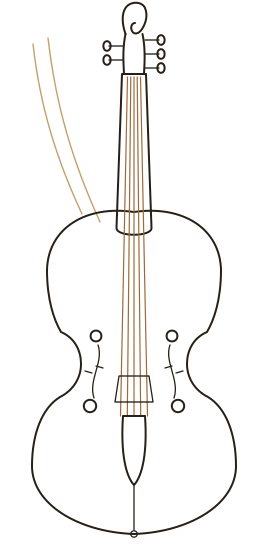
Violoncello da spalla
Violoncello da spalla — “the cello of the shoulder”A small five-string cello, hung from the shoulder on a strap and held across the body like a violin. Used in Bach's time and then forgotten, it has returned to Baroque stages in recent years, and stands at the centre of the discussion about which instrument Bach's unaccompanied cello suites were written for — particularly the sixth, BWV 1012, which calls for five strings.
It lets violinists and violists sing the cello register directly. Drawing cello depth out of so small a body asks for more precision in plate graduation, arching and string length than a standard instrument does. Research continues to suggest that the violoncello piccolo parts of Bach's church cantatas were written for this instrument.
▶ Listen — the sound of the violoncello da spalla
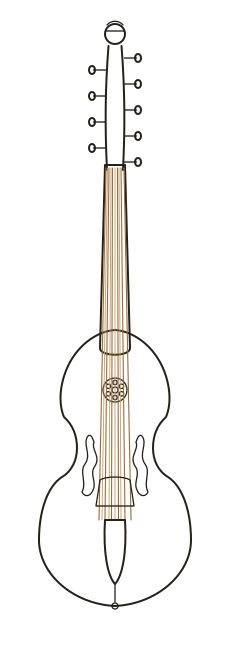
Viola d'amore
Viola d'amore — “the viola of love”Beneath the playing strings, where the bow never reaches, run sympathetic strings that sound of their own accord. Six or seven playing strings and as many sympathetic ones leave behind a halo of overtones that no other string instrument gives. The flame soundholes and the blindfolded head of Amor are its emblems.
Loved by Vivaldi and Telemann, revived by Hindemith — and a demanding instrument to build, since it must carry twice the number of strings while keeping a thin, responsive top. VIOLZ delivers it complete, with the sympathetic strings tuned and the set-up done. In the St John Passion, Bach entrusted two of his most inward arias to it.
▶ Listen — the sound of the viola d'amore
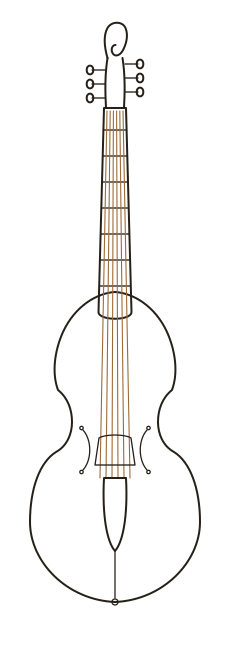
Viola da gamba
Viola da gamba — “the viola of the leg”Held upright between the legs, this is the heart of the viol family. Sloping shoulders, C-shaped soundholes, a fretted fingerboard like a lute's, six or seven strings — a different lineage from the violin family altogether, and the voice that carried the bass line with such poise in Renaissance and Baroque chamber music.
From the French viol music of Marin Marais and Sainte-Colombe to Bach's gamba sonatas, its nature lies in dynamics fine enough to whisper. The flat back, the light structure — a grammar of construction quite unlike the violin family's — are followed as the historical sources have them. It is this instrument, too, that sings beside the aria of the Cross in the St Matthew Passion.
▶ Listen — the sound of the viola da gamba